
Honesty Is the Best Policy: What To Tell Your Mortgage Lender About Financial and Personal Changes
Borrowers should notify lenders regarding significant personal or financial changes before closing, so the home loan application and funding terms are accurate. Mortgage application updates alone do not automatically mean a denial; waiting too long to communicate these changes can commonly complicate or delay funding.
Find out what changes to tell your lender about, how to document updates, and why a new job, debt, or marital status may affect mortgage approval.
Why Lenders Need Updated Information
A significant amount of time can pass between the pre-approval process and the closing date. The shelf life for bank statements and financial snapshots could expire before the funds are disbursed. A lender may need to reverify certain information on the original application or pre-approval to ensure its accuracy.
Lenders look for any changes in:
- Employment
- Income
- Debt-to-income (DTI) ratio
- Credit
- Assets
- Down payment
- Loan eligibility
If you supply documents for reverification that show a new deduction or a name change, the lender is likely to follow up with you and review your application, which can delay funding decisions.
Accuracy is important for the institution’s risk assessments and asset monitoring, and it also helps make sure you’re still borrowing an amount that fits your finances.
Financial and Personal Change You Should Always Discuss With Your Lender
While very minor changes may not have an immediate impact on your loan application, you may be more surprised at how many situations do. This chart shows which personal and financial changes should be reported to your lender, why each matters, when to alert your loan officer, and what documentation you might need to make mortgage application updates.
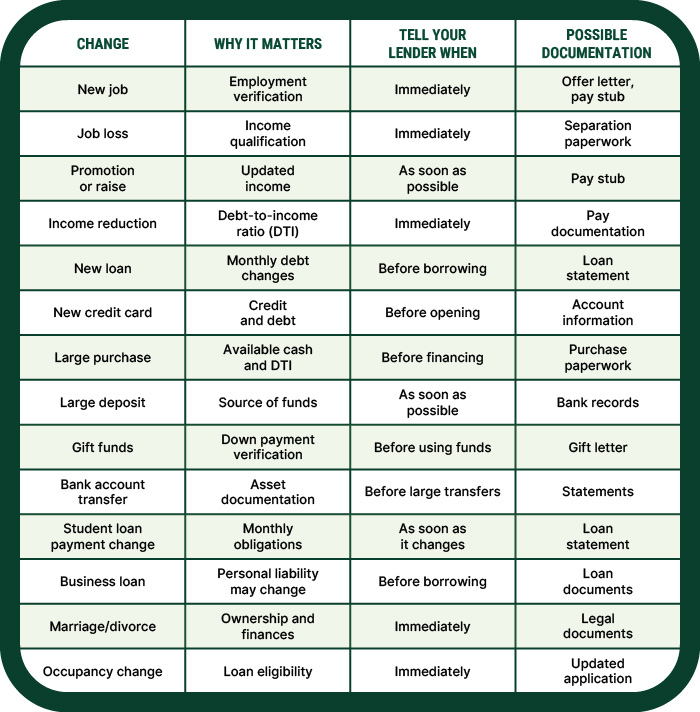
If you aren’t certain if a change needs to be reported, just ask. Your lender can usually tell you within minutes whether additional information is needed.
Employment and Income Changes
Because lenders typically perform a final employment verification right before funding a loan, a borrower should consider reporting any job or financial change—even a minor or positive one—to help prevent unexpected delays.
- If your income decreases, your qualifying loan could decrease, which may require changes to the loan, down payment, purchase price, or closing timeline.
- If your income increases, the change may still trigger a review and potential funding delay.
- If your pay structure changes from salary to commission or from a W-2 to a 1099, you may need to provide documentation of the change and other financial records.
New Debt, Credit Applications, and Major Purchases
When a home loan goes through underwriting review, your ability to repay the amount is evaluated based on your current financial situation, and if this includes new debts, credit inquiries, and reduced cash reserves, it may impact the lender’s decision. For this reason, borrowers should generally avoid taking on new debt or opening new credit accounts before closing, including financing furniture, appliances, electronics, or other major purchases.
Financial Decisions that Should Trigger a Call
Before applying to finance anything new, call your lender to inquire how it might impact your credit, debt-to-income ratio, and mortgage approval. This includes installment loans, store financing, new credit accounts, cosigning loans, or borrowing against assets such as your 401(k) or taking a Home Equity Line of Credit or HELOC.
Does a Soft Credit Check Affect a Mortgage?
Soft inquiries do not generally affect your credit or a mortgage application, but any new debt you take on after the credit check can change your financial status and impact the lender’s decision.
Bank Accounts, Transfers, and Down Payment Funds
Bank account balances, transfers, and down payment funds can be scrutinized as heavily as debt. Large transfers between accounts, deposits for liquidated funds, or large sums of money, even if it is a gift, can complicate the paper trail. Unexplained deposits, gifts, or unapproved asset transfers can prompt an application review.
If you aren’t able to keep your money frozen, move it as early in the application process as possible, verify which financial changes your lender needs to know about, and prepare to show financial records.
Should I Disclose All My Bank Accounts?
Borrowers should provide truthful information about any accounts required to qualify for a loan. Generally, assets, debts, and transfers relevant to the application will need to be disclosed, verified, and the activity reviewed.
Can an Overdraft Affect a Mortgage Application?
One overdraft doesn’t necessarily cause an automatic mortgage application denial. The frequency of these events, the timing in proximity to your closing date, your overall banking history, and the availability of closing funds all come into play.
If a financial situation arises and you do not have overdraft protection, tell your lender about the shortfall rather than hiding it.
Student Loans and Business Loans
Student and business loans, even if deferred or paid by someone else, may affect qualifying obligations for home loan eligibility depending on the available documentation and program requirements.
- When student loans exit a deferment or forbearance period and enter active repayment during underwriting, it can trigger loan restructuring or approval delays due to reevaluations and documentation.
- Business loans can complicate a mortgage application, depending on how the corporation is structured and whether you personally guaranteed the debt.
To request that business debt be excluded from your personal DTI, the lender may require documentation, such as:
- A separate account for personal checking and company finances
- Records of reliable, consecutive loan payments made from the business bank account
Personal Life Changes That May Affect Your Mortgage
Major life changes, such as marriage, alimony, or a name change, can impact your application. You should disclose these events to your lender and prepare to provide official records, such as a marriage certificate, divorce decree, separation agreement, and new identification, if relevant.
Occupancy or Property Changes
Mortgage programs may have different requirements depending on whether the loan is for a primary residence, a second home, or an investment property. Notify your lender immediately if your plans change, which may require updated disclosures, underwriting, or loan terms.
What Can a Mortgage Lender Not Ask?
Mortgage lenders may request personal and financial information, but they may not ask for information in violation of fair lending laws, which restrict lenders from discriminating based on protected characteristics.
What Happens After You Tell Your Lender Something Changed?
Reporting a change may initiate a review, an updated application, or an additional documentation request, but it does not automatically mean your mortgage will be denied. Here’s the general process after reporting a personal or financial change.
Your Lender Reviews the Change
Your loan officer or underwriter will first determine whether the change affects your income, debts, credit, assets, down payment, occupancy, or eligibility for the selected mortgage program.
A small change may require no action. A more significant event may require the lender to recalculate your qualifying ratios or verify information.
You May Need to Update Documentation
Depending on what changed, your lender may ask for relevant records, statements, official notices, or court orders. Provide the requested information promptly and completely. Missing pages, unofficial copies, or incomplete records may slow the review.
After reviewing the documents, the lender may decide any of these possible outcomes:
- Nothing needs to change.
- The documentation you supplied will be added to support the file.
- Your approval may be updated.
- Your eligible loan amount or required down payment may change.
- Closing may be delayed.
- A different loan program may be recommended.
- The borrower may no longer meet the original approval requirements.
Early communication can give you and your lender more time to evaluate the available options to resolve any issues the mortgage application update causes before closing. This also helps allow time for the loan to be restructured or changed, should that be necessary.
How To Tell Your Lender About a Financial Change
You do not have to solve the issue before you speak to your loan officer. Contact your lender right away, ideally before you make any change, explain the situation clearly, and let them identify next steps.
This message does not need lengthy personal details or to solve the problem; it only needs to:
- Explain the concern clearly, including when it occurred or will occur.
- Request information on what follow-up documentation is needed.
- Agree to avoid additional changes, and let the loan officer know you’re awaiting guidance.
Questions to Ask Your Mortgage Lender Before Closing
Asking your mortgage lender questions before closing is a good way to prevent surprises at the last minute and clarify final application reviews and deadlines:
- What personal or financial changes should I report immediately?
- What financial decisions or transactions should I notify you for?
- Will you verify my employment again? When?
- How might potential life changes impact a closing timeline?
- What dollar amount or actions might trigger a re-underwrite?
- When is my loan officially final?
Start your loan application today. Contact Heritage Family Credit Union or visit a local branch for in-person assistance, from pre-approval to closing.